Preserving Real Art in a World of AI
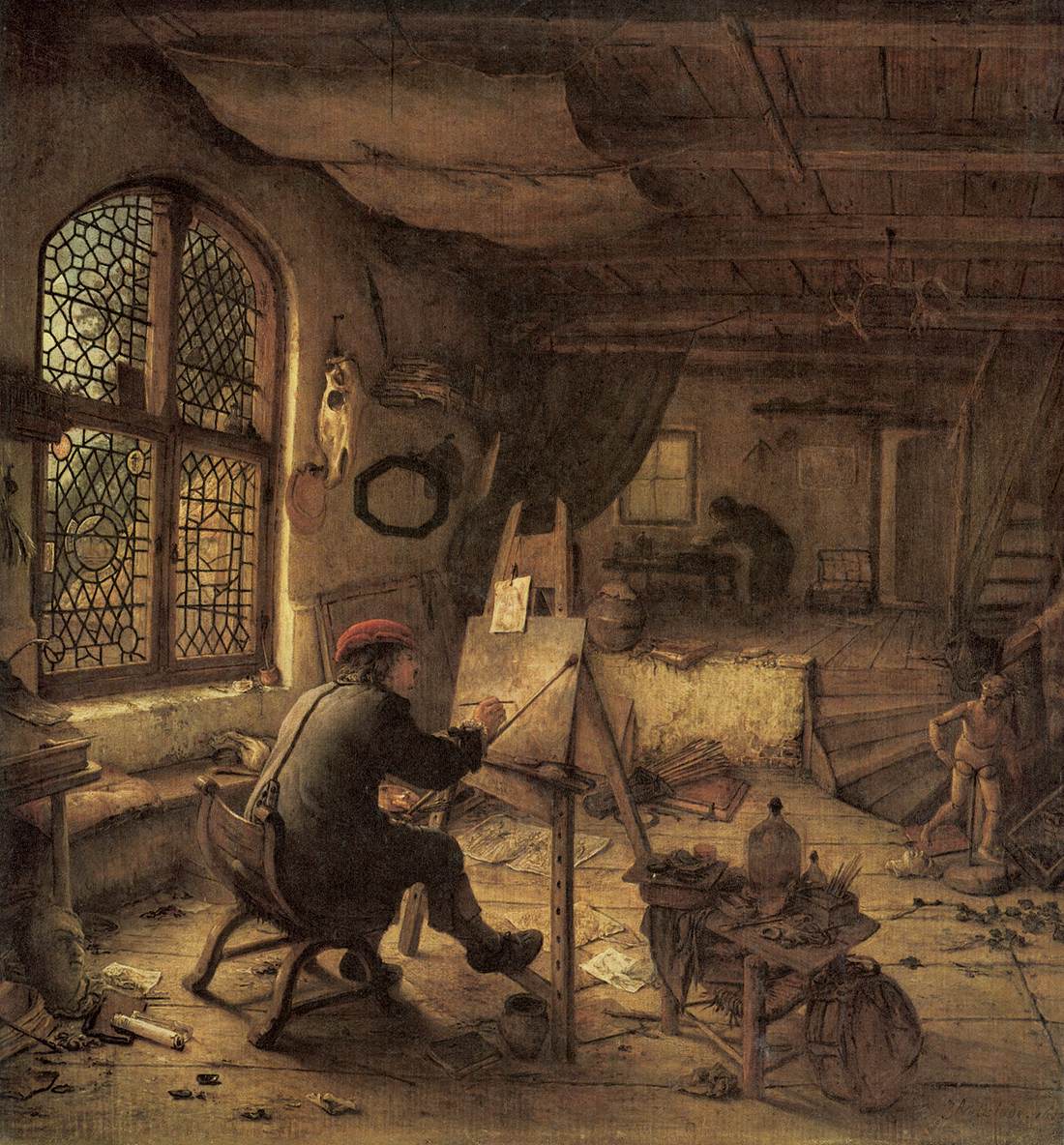
A version of this essay first appeared in the Preservation issue of Commonplace.
The term revolutionary used to mean something before it was hijacked and inflated by the tech industry to hype its latest innovations. Even so, there is no better word to describe the effects of artificial intelligence. We are at a significant historical turning point, with all the anxiety that such major cultural shifts tend to inspire.
The sense of unease, even doom, is especially keen among creatives. Except for a few outliers willing to bend the knee to technological inevitability, artists are increasingly angry at the relentless intrusion of AI into creative spaces.
Of course, as techno-optimists are keen to point out, technology has been disrupting our relationship with art for as long as we have been building machines and making art, disruptions that have usually inspiredapocalyptic doomsaying, which later turns out to be hyperbolic: writing will replace oral storytelling, the printing press will replace writing, movies will replace novels, photography will replace painting. In most cases, the new form finds its place alongside the old, which never fully goes away.
But the AI revolution is more than a disruption. It is not simply a matter of technology giving us another tool to work with, as has been happening throughout human history. As Paul Kingsnorth writes in a recent article,
We all use “tools” of some kind to do this [create], like the keyboard I am now writing on. But AI is different. It does not help you to do your job; it does your job for you. It sucks up from the worldwide web the usings and doings and scrapings of the already-created and it rearranges them, pretending all the while that it has “created” them itself. It imitates reality but can never replace it. It is, at root, a shabby, boring and actually evil thing. It is the end of art.[1]
This is stark, but the more I see what AI is doing to real art and real artists—competing for space on Spotify playlists, bloating our social media feeds with slop, infringing on intellectual and creative property rights (in other words, stealing)—the more I am inclined to agree with Kingsnorth’s assessment. Tools help artists do their work; AI masquerades as a tool while eroding the heart of the creative vocation.
If there is any encouragement to be found in the historical battle between humans and the often monstrous machines we create, it is that revolutions usually inspire counterrevolutions. The Arts and Crafts movement of the late-19th century emerged at the height of the Industrial Revolution to reassert the dignity of human craftsmanship against the fragmentation and mechanization of industrial capitalism. The spirit of this movement continues to animate the recent revival of traditional arts and crafts (blacksmithing, leathercraft, pottery, woodworking, bookbinding, embroidery) among my own generation of tech-weary Millennials.
Much as the wilderness movement around the turn of the 20th century sought to preserve wild spaces against the creep of human civilization, we need to preserve creative spaces against the creep of artificial intelligence.
This essay attempts to nurture that effort by exploring three questions: What is real art? Why does it matter? And how can we help to preserve it?
What is real art?
Any discussion of real art and AI is complicated by the awkward etymological kinship between art and artificial. At the semantic level, real art is something of an oxymoron, as art denotes that which is made by human craft in contrast to something that occurs in nature—the really real.
But the semantic paradox of real art is productive because it forces us to consider what it is that we experience as real (truthful, meaningful) in art, even when we know that it originates in the imagination: that it is made up. How can something made up be real?
This question belies a common misunderstanding of imagination as something potentially interesting but ultimately untrue and unnecessary, a misunderstanding reinforced by our disenchanted modern materialism and our no-nonsense Anabaptist pragmatism.
We imagine because He first imagined us. We create because we are made in the likeness of our Creator. Consequently, our art can be real or unreal, true or untrue, to the degree that it harmonizes with the reality and truth of creation.
Christian artists, however, have long understood the imagination as something essential to human experience, something more akin to inspiration and revelation than whimsical fancy. The Victorian pastor and fantasy author George MacDonald defines a “wise imagination” as no less than “the presence of the spirit of God,” which harmonizes with the truth of creation.[2]
Human imagination testifies to the reality of our being made in the image of God, as Christian thinkers from Sir Philip Sidney to Dorothy Sayers to Malcolm Guite have pointed out. We imagine because He first imagined us. We create because we are made in the likeness of our Creator. Consequently, our art can be real or unreal, true or untrue, to the degree that it harmonizes with the reality and truth of creation.
Why does real art matter?
Real art clarifies real life; it does not obscure reality or detach us from it. Real art invites us into an imagined world so that we can return to the real world with clearer eyes and purer hearts. In the day-to-day routines of modern life, the eyes of our hearts become clouded, and we struggle to believe. Art gives us glimpses of the far country we all long for, the kingdom of heaven already at hand, just on the other side of the veil. In doing so, it restores our faith.
The best art—the kind that nourishes us and makes more human—is not a solitary activity of passive consumption but one that calls us out of ourselves toward participation and relationship. A good story draws us into the lives of characters who are radically different from us. Yet in that difference, we sense remarkable similarity, whether the story is taking place in the antebellum South, a downtown high-rise apartment, or a distant planet in a fantasy world. Through stories, we experience what C.S. Lewis called an “enlargement of our being” and a “temporary annihilation of self.”[3] Paradoxically, it is this very annihilation that sends us back to our world with a refreshed heart and clarified vision.
Similarly, a good film offers us the immediacy of a soul-nourishing escape into the lives of others. A poem gives us just the right metaphor for the feeling we didn’t know we had until reading it. A sculpture immerses us in the pathos of a particular moment chiseled into being by the artist’s hammer. The opening line of a Bach chorale breaks open our desiccated souls and floods us with hope; we understand it even if we don’t know German or the music theory behind chord progressions. Art always speaks beyond words, even when it uses words.
Art connects us with flesh-and-blood others as well, not simply with imagined characters in stories. “You too?!” we exclaim, as a poet gives us a way of seeing the world that resonates with our own. “Listen to this!” we implore a friend, as we discover a new album by our favorite musician.
Beauty insists on being shared; it is never satisfied with being consumed greedily in private. And there are few things more fulfilling than finding others enjoy the same books, music, movies, and art that you do. Therein lies the possibility for true friendship, the kind of friends Anne Shirley would call “kindred spirits.”
If real art is essentially about human experience (by, about, and for humans) AI-generated art is unreal by definition because it does not originate in human experience. An artificial intelligence cannot feel the grandeur of human existence: its deep sorrows and sublime joys, the inexhaustible mystery of our brief parenthesis between birth and death. It may be able to construct a semblance of this experience based on what it can patch together from the storehouse of real art it feeds on, but it can never fabricate soul—that intangible quality that comes only from real experience, deep attention, the hard work of artistic mastery, and the miracle of creative inspiration.
This is not to say that original art is good simply by originating from a person rather than a machine. In fact, much human art is cheap, boring, and soulless because it lacks originality and artistic vision. But AI art is intrinsically soulless because it is disconnected from flesh-and-blood human experience.
The false promise of AI-generated art is that anybody can be an artist without struggle or sacrifice. You don’t need to spend years learning music theory to compose a hit song. Just type the prompt. Why spend countless hours learning how to hold a paintbrush if you can generate a picture by feeding the machine the right sequence of words? If you can think it, you can create it (or at least the bot can make it appear as if you did).
But real art is always characterized by struggle, sacrifice, and plain hard work. These are not hindrances to be wished away or short-circuited by technology but the pathways to true meaning. It is precisely in the struggle that our capacity for attention is grown, which is the primary spiritual benefit for creating art in the first place. The act of creation attunes us to creation itself, and to its Creator. It compels us to be present with our materials, to listen to the Spirit, to give the world our attention.
Creativity is not all mystery and sublime epiphanies, however. The artistic encounter with rock-hard reality is often a painful lesson in humility. The paint drips, the marble chips, the violin squawks, our fingertips hurt from fretting the guitar one more time, and our heads ache for want of that one necessary word to complete the line of poetry. I have yet to encounter a writer worth reading who doesn’t find writing difficult. All writers can sympathize with T.S. Eliot when he laments the “intolerable wrestle with words and meanings”[4] (even if we don’t share his indefatigable pessimism). But it is precisely in this intolerable wrestle that meaning is forged.
True artistry is marked by its respect for the constraints and possibilities of physical reality, both of our bodies and the world around us. And as artists throughout history have discovered, there is a truer freedom to be found within the boundaries of physical and formal constraints than in the boundless, frictionless freedom championed by technology. Constraints are also possibilities, and the master artist is a master only to the degree that he works with the limitations of his tools and materials.
To be a master artist is also to be mastered—by the tools, by the media, and by the artistic tradition within which one works. The visual artist submits to the unique qualities and limitations of oil, water, pencil, stone, or canvas. The master violinist works within the constraints of four strings, ten fingers, and the notes written by a composer several centuries ago. The master poet surrenders to the reality that words cannot mean anything he wants them to mean. As contemporary poet Malcom Guite stated at a recent literature conference, “All the words we use are older and wiser than we.”
The dabbling I’ve done with poetry has convinced me that the artistic task is as much an exercise in discovery as it is creation. My better poems always surprise me by taking on meanings and creating resonances that I never intended. Based on what I have heard from other artists, this is not uncommon. Artists often describe a sense of being “carried along” in the flow of the creative process.
In a world infused by the presence of its Creator, how could it be otherwise? The Muse is real, and he has a name.
All of this points to the reality that artists are never creators as such. We are always what J.R.R. Tolkien called “subcreators,”[5] working under the ultimate authority of God, using the materials and tools he so graciously gives us. At best, we are children playing in our Father’s workshop.
But the AI revolution would delude us with visions of creativity without struggle, mastery without surrender, inspiration without spirit, being without becoming.
These are the empty lies we must resist. But how do we do so, short of cloistering ourselves on a remote mountaintop (not the worst option, let’s be honest)?
Following are three ideas to consider.
How can we help preserve real art?
Go analog
Analog has been trending for a while now, as digital natives discover the tactile joys of vinyl records, polaroid cameras, and typewriters. But it may be time to turn the trend into a full-scale rebellion based on principle.
As a product of our digital age, AI will continue to thrive in digital spaces unless tech companies take a principled stance against it or are forced to by law, neither of which is likely to happen anytime soon. Until then, we can resist its dominance by abandoning (or at least reducing our use of) digital streaming services and purchasing recorded music and attending live performances.
This not only encourages intentional listening, but it also channels more money to the artist instead of the streaming platform.
Look local
We tend to think of art as happening primarily in the museums, concert halls, and theaters of the urban cultural districts. This causes us to overlook the often-vibrant arts scenes in our own backyards.
In one of the happier holdovers from the pandemic, the Erie Philharmonic Orchestra plays free outdoor concerts in local city parks every summer, including our own Diamond Park here in Meadville. This annual concert draws a crowd of over a thousand eager listeners, sprawled across the park grounds on picnic blankets and lawn chairs, with children dancing during the rousing movements or playing in the dirt during the calmer ones. This is hardly the turnout one would expect for an evening of classical music in a Rust Belt town in western Pennsylvania, but it demonstrates how beauty speaks across class and geographic lines.
Artificial intelligence dehumanizes art by disconnecting it from real people. Local art rehumanizes it by connecting us to real people we can see, know, and even love.
Get involved
Perhaps the best way to nurture real art is to go from being a passive consumer to being a creator. Not all who love art are necessarily called to be professional artists. But the best art always invites participation, even if only as an amateur.
The word amateur carries the unfortunate connotation of someone who is unskilled or perhaps unserious about his craft. But originally, the word identified those who do something simply because they love it, with little thought to professional or economic gain. Love is quite literally at its root: the word comes to from the Latin amare meaning “to love.”
To be an amateur artist is to be a lover.
So, if you love music, pick up that instrument you’ve always wanted to play and start taking lessons. If you love literature, join a writing group and try your hand at poetry or fiction. If you love art, turn a corner of your house into a studio and start painting.
Embrace the spirit of amateurism—because it is only through love that the arts will be saved from the inhumanity of artificial intelligence.
For those of us with artistic sensibilities, it is tempting and all too easy to respond to technological revolutions with woeful jeremiads pining for a lost age of real art. But such a response is neither helpful nor wise.
In a poignant scene from Tolkien’s epic saga, The Lord of the Rings, a despondent Frodo Baggins wishes aloud that the force of evil they were up against “need not have happened” in his time. The wizard Gandalf’s reply is as sympathetic as it is profound: “So do I…and so do all who live to see such times. But that is not for them to decide. All we have to decide is what to do with the time that is given us.”[6]
Let’s use the time given to us to recover and display for a disenchanted world what it means to be truly human: creatures who share the creative spirit of their Creator.
Photo by Joel Engbretson
To read this essay via PDF, click the button below.
[1] Paul Kingsnorth, “News & Views: July,” The Abbey of Misrule, Substack, July 12, 2025, https://paulkingsnorth.substack.com/p/news-and-views-52e.
[2] George MacDonald, “The Imagination: Its Function and Its Culture,” A Dish of Orts, https://www.gutenberg.org/files/9393/9393-h/9393-h.htm#link2H_4_0002.
[3] C.S. Lewis, An Experiment in Criticism, Cambridge University Press, 1961, pp. 137-138.
[4] T.S. Eliot, “East Coker,” from Four Quartets, in Collected Poems: 1909–1962, Harcourt, Brace & World, 1962, pp. 184.
[5] Tolkien, “On Fairy Stories.”
[6] J.R.R. Tolkien, The Lord of the Rings, 50th Anniversary One-Volume Edition, Mariner Books, 2005 (originally published 1954), pp. 51.